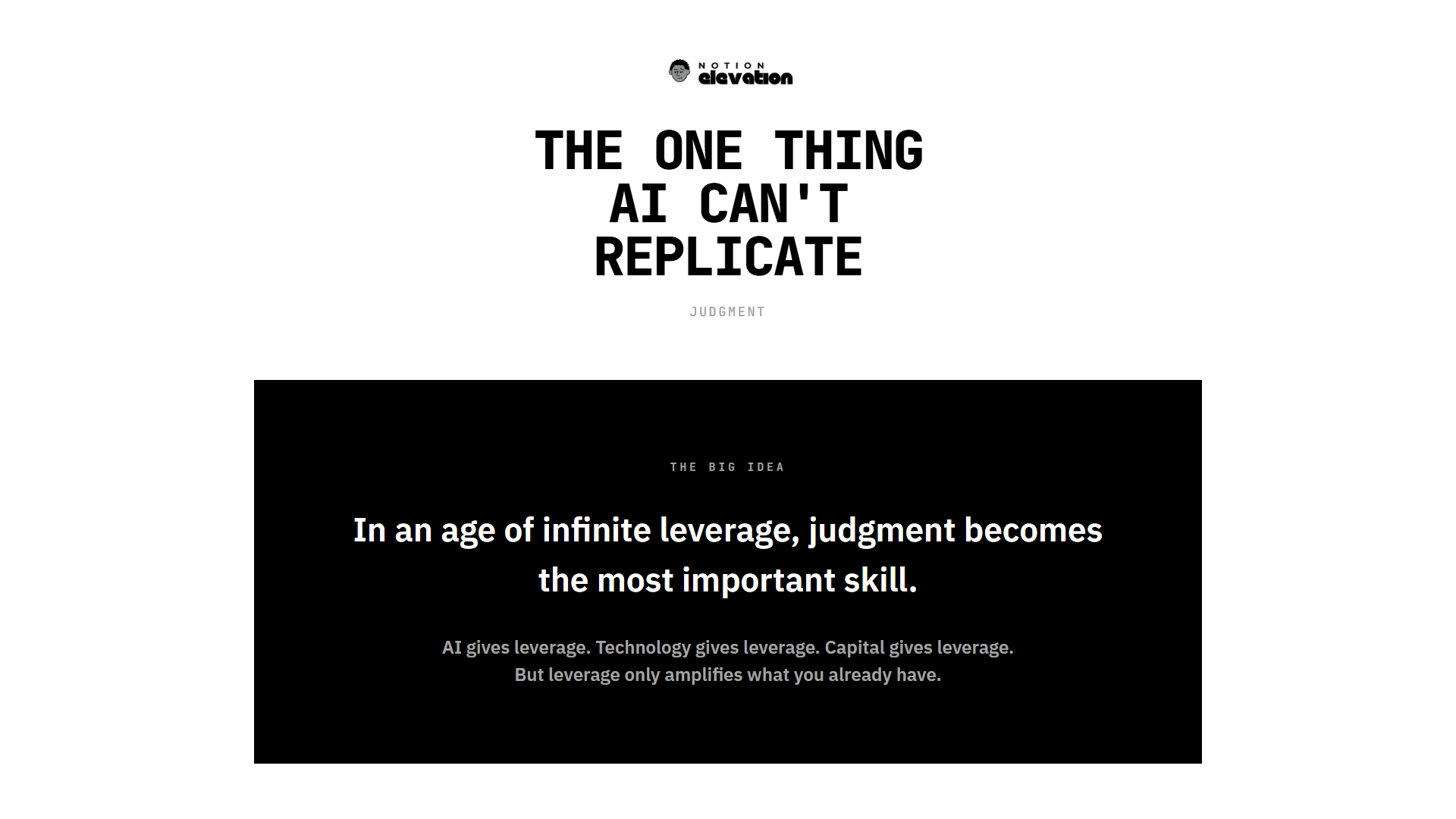
AI creates infinite leverage, but judgment determines results. Learn why judgment, experience, and long-term thinking remain irreplaceable in the AI era.

AI Can’t Replicate
AI gives you leverage. Capital gives you leverage. Technology gives you leverage.
But leverage only amplifies what you already have.
The missing variable is judgment.
Everyone has access to AI. Everyone has access to the same tools, the same information, the same infrastructure. So what separates the people who build something lasting from the ones who just build a lot?
It’s not intelligence. It’s not hustle. It’s not even experience. It’s the quality of your decisions under uncertainty. That’s judgment. And no model can hold it for you.
Leverage?
Point
Matters
Proof
Really Is
Short
vs Intellect
Control
Build It
Infinite output.
Leverage is force multiplication. You do something once and its impact scales beyond your direct effort. A video posted online. A system built in Notion. A codebase shipped. These things keep working when you’re not.
There have always been four kinds of leverage — and AI has just made three of them almost free.
Using it wisely is phase two.
At scale, small decisions create massive consequences. A post that reaches a million people. A system used by thousands. A product that shapes how people think. The same action that was low-stakes before leverage becomes high-stakes after it.
You are no longer steering a sailboat where a bad turn means a wet afternoon. You’re steering an ocean liner. Every turn has weight, lag, and consequence.
= amplified mistakes.
Judgment is what decides where your leverage is applied, when to act, when to wait, and — most critically — what not to do. It’s the steering mechanism. Without it, you have an engine but no wheel.
proven judgment.
Why does the world trust Warren Buffett? Not because he’s the fastest. Not because he has the best software. Not because he hustles 18-hour days. It’s because he has a 60-year public track record of sound judgment — repeated, accountable decisions that played out in front of everyone.
consequences of decisions.
Judgment is not IQ. It’s not analytical horsepower. It’s the ability to see forward — to understand that this decision today produces that outcome in six months, and that outcome in three years.
Wisdom is personal judgment: it affects your own life. Judgment, at scale, is wisdom applied externally. The skill is identical. The stakes are different.
AI cannot judge.
AI is an extraordinary tool. It can analyze patterns at superhuman scale, predict probabilities across enormous datasets, and optimize for any metric you define. But it carries no consequences. It has no skin in the game. And that absence is exactly what prevents it from developing judgment.
- Analyze patterns at superhuman scale
- Predict probabilities with high accuracy
- Optimize for any metric you define
- Generate infinite options in seconds
- Surface information you’d miss alone
- Carry accountability for being wrong
- Feel the long-term consequences of decisions
- Develop lived intuition through iteration
- Have skin in the game
- Know what you actually value
experience is dangerous.
The brilliant analyst with no operating experience makes confident predictions that don’t account for how humans actually behave under pressure. Intellect without consequence produces certainty without accuracy.
Judgment is forged in iteration. Not reading about iteration. Not thinking about it. Actually trying, failing, feeling the cost, adjusting, and trying again. The loop closes only when something is at stake.
the least emotional.
Emotion distorts the lens. When you’re excited, risks look smaller. When you’re anxious, opportunities look scarier. When you’re angry, consequences feel irrelevant. None of these are accurate readings. They’re noise layered on signal.
The goal isn’t to remove emotion. It’s to make decisions from the part of you that can see clearly. Emotional regulation isn’t cold — it’s clean. The difference between reacting and responding.
It is compounded.
You don’t get judgment from a course. You don’t get it from a book. You get it from the intersection of experience, reflection, broad thinking, and emotional restraint — repeated over long periods of time, with consequences attached.
is preparing you to judge.
Every project. Every failure. Every late-night decision you had to make without enough information. Every time you ignored your gut and regretted it. Every time you trusted your gut and it was right. You are building a decision-making machine. That machine is your most valuable asset in an age of infinite leverage.
AI scales effort. Technology scales reach. Capital scales ownership. But judgment scales outcomes. It is the only multiplier that gets stronger the more it’s used — and it cannot be downloaded, copied, or delegated.
judgment — not
intelligence.
AI gives you extraordinary leverage. The question is never whether you have enough tools. The question is whether the person holding the tools has the judgment to aim them correctly. Develop judgment. Protect it. Exercise it. It is the one thing that compounds quietly — and the one thing no model will ever replicate.
NOTION ELEVATION NEWSLETTER"[Retired four-star general Gustav] Perna says Palantir did exactly what it promised. Using AI, the company optimized thousands of data streams and piped them into an elegant interface. In a few short weeks, Perna had his God view of the problem. A few months after that,…
— Palantir (@PalantirTech) March 11, 2024
FAQs
Can AI replace human judgment?
No. AI can analyze data, detect patterns, and optimize for predefined goals, but it cannot replace human judgment. Judgment requires understanding long-term consequences, taking accountability for decisions, and applying wisdom gained from real-world experience things AI does not possess.
Why is judgment more important in the age of AI and automation?
AI creates massive leverage by scaling effort, but leverage amplifies decisions good or bad. As tools become more powerful, the quality of judgment behind decisions matters more than speed or intelligence. Poor judgment at scale leads to amplified mistakes, while good judgment compounds results.
How do people develop strong judgment that AI can’t replicate?
Strong judgment is developed through experience, accountability, and repeated real-world decision-making. It improves by learning from long-term outcomes, iterating quickly, managing emotions, and thinking broadly across disciplines such as history, philosophy, and systems thinking.
Related Images