Learn how to build scalable success by eliminating unnecessary complexity. A practical simplicity framework inspired by Naval Ravikant and Elon Musk.

Simplicity
Framework
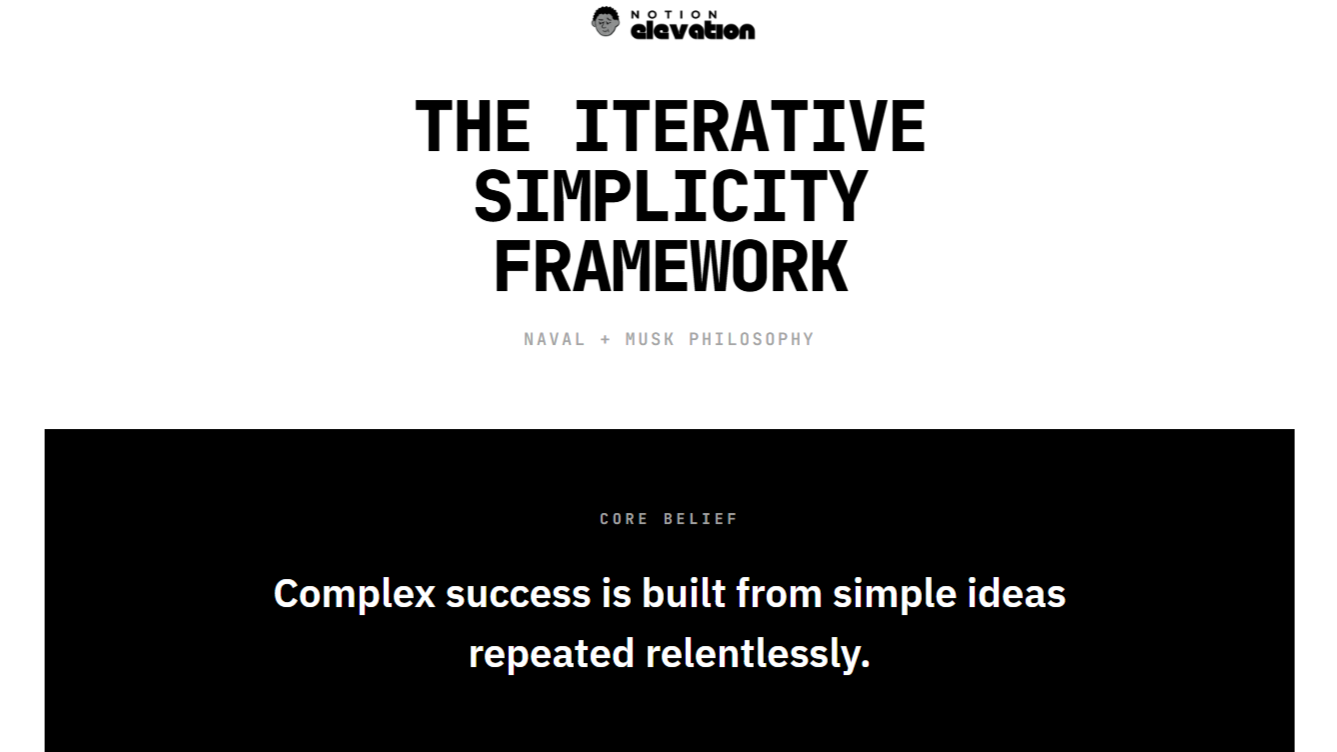
Complex success is not built through complexity.
It is built from simple ideas — repeated relentlessly until they compound into something extraordinary.
Every overbuilt product, every failed strategy, every burnt-out team — they share one trait. They tried to scale complexity before they’d mastered simplicity.
Musk calls it the “idiot index.” Naval calls it specific knowledge from loops. The framework below is what they actually do.
Simple
All
First
Loop
System
Polymath
Last
that actually works.
Begin with what solves the one core problem — not what impresses, not what’s optimized, not what’s complete. A product that does one thing cleanly will always beat a product that does ten things messily.
Musk’s first principle: define the goal in its simplest form. Every constraint you add after that must justify its existence from first principles — not from convention.
attack assumptions.
Musk’s algorithm starts here: every requirement must have an owner and a reason. Not “this is how we’ve always done it.” Not “someone told us to.” A specific human, accountable, with a specific reason that still holds today.
Most requirements survive because nobody questioned them. The ones that don’t survive questioning were never real requirements — they were inherited complexity masquerading as necessity.
- WHO OWNS THIS? — Name one person accountable for its existence. If you can’t name them, it doesn’t belong.
- WHY DOES IT STILL EXIST? — The reason it was added may no longer apply. Challenge it on current conditions, not historical ones.
- WHAT BREAKS IF REMOVED? — If the honest answer is “nothing critical,” remove it. Requirements that survive this test are the ones worth keeping.
clutter.
Optimizing a broken system makes a more efficient broken system. Musk’s algorithm is explicit: remove first, simplify second, optimize only last. Violate this order and you are compounding waste.
- Eliminate unnecessary parts — if it doesn’t serve the core function, it leaves first
- Simplify what remains — reduce the complexity of every surviving component
- Only then optimize for speed, cost, or efficiency — you are now building on clean ground
all work this way.
Evolution doesn’t redesign from scratch each generation. It makes tiny adjustments, tests them against reality, and keeps what survives. Great products work identically. The loop isn’t glamorous — but it’s how everything actually compounds.
Naval: “The specific knowledge that earns you wealth comes from doing the loop so many times that it becomes effortless intuition.” You don’t shortcut the loop. You run it faster.
is how you decide well.
Musk famously insisted on understanding every system SpaceX built — not to do every engineer’s job, but so no engineer could BS him. The leader who holds the whole system can spot the second-order failures that specialists miss because they’re only looking at their part.
This is not micromanagement. This is systems fluency. You need to understand why each component exists, what disappears if it leaves, and how any change ripples across everything else.
- WHY EACH PART EXISTS — Not what it does — why it’s there. The distinction matters when the system needs to change.
- WHAT HAPPENS IF IT DISAPPEARS — Second-order effects. Most people only see first-order. The best systems thinkers see three levels deep.
- HOW CHANGES RIPPLE — Every change has unintended consequences. Holding the whole system means you can see them before they hit.
100% better decisions.
The specialist goes deep in one domain and is catastrophically blind outside it. The polymath goes 80% deep in many domains — and the overlap is where the real insights live. Naval calls this the “foundational ideas with the widest reach.”
- ◆Learn the fundamentals with the widest reach — physics, systems thinking, probability, logic
- ◆Aim for 80% understanding — enough to reason, not enough to be an expert. Move on.
- ◆Build things, then study — tinkering generates questions that studying alone never produces
reward for survival.
Scaling before reality-testing is the single most common way startups and projects die expensively. You scale a broken thing and amplify every flaw. You take on costs, headcount, and complexity — then discover the core didn’t work.
The gate is simple: has it survived removal? Has it survived iteration? Has it survived real-world testing against real users with real stakes? If yes to all three — now you scale. Not before.
- SURVIVED REMOVAL — You attacked every requirement. Only the essential survived. You know why each part is there.
- SURVIVED ITERATION — You ran the loop. Built, tested, removed. The core proved durable across multiple cycles.
- SURVIVED REALITY — Real users. Real stakes. Real feedback that wasn’t curated by your optimism. It held up.
Scale what survives.
NOTION ELEVATION NEWSLETTER“A complex system that works is invariably found to have evolved from a simple system that worked. A complex system designed from scratch never works and cannot be patched up to make it work. You have to start over with a working simple system” Galls Law
Simplicity Framework Related Image