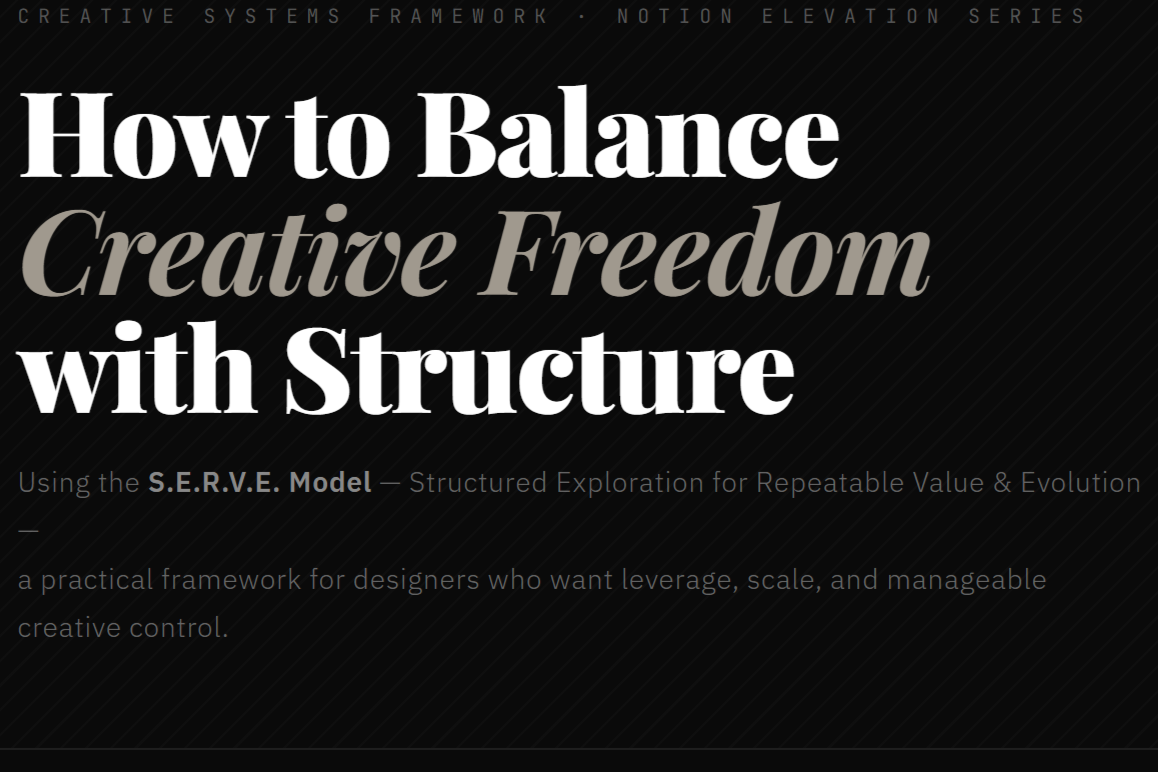
Discover how Creative Systems help designers balance structure and flexibility. Learn a practical framework that turns creativity into scalable, repeatable, and innovative results without limiting originality.
When Apple Inc. set out to build the first iPhone under the leadership of Steve Jobs, it wasn’t a burst of random genius it was disciplined creativity. The team worked within strict constraints: no keyboard, full touchscreen, extreme simplicity. Those boundaries gave them direction. Inside that structure, they experimented boldly, prototyped relentlessly, and killed ideas that didn’t align with the vision. They tested, refined, and simplified again until the product worked beautifully in the real world. And when it succeeded, they didn’t stop they evolved it into an ecosystem that scaled globally. The lesson is simple: creative breakthroughs don’t come from chaos or control alone. They come from building a backbone, exploring within it, reflecting honestly, testing in reality, and upgrading what works. Structured freedom isn’t limiting it’s what turns imagination into impact.
Creative Systems Summary

S.E.R.V.E. Framework
Creative Freedom
with Structure
A practical framework for designers who want leverage, scale, and manageable creative control.
- Define the problem clearly
- Identify constraints & requirements
- Clarify direction & strategy
- Establish production process
- Define review checkpoints
- Free ideation — no filters
- Experimental directions
- Style deviation & variation
- Unfiltered concepts
- Am I repeating myself automatically?
- Has my style become a box?
- Is this safe — or truly effective?
- Is this driven by habit or intention?
- Align with user & client needs
- Test feasibility of ideas
- Filter through constraints
- Refine for clarity & usability
- Document what worked
- Integrate into your workflow
- Upgrade your system continuously
- Turn creativity into leverage
- —Define the problem clearly
- —Identify constraints & requirements
- —Clarify direction & strategy
- —Production → Review cycle
- —Free ideation — no filters
- —Experimental directions
- —Style deviation & variation
- —Unfiltered concepts
- —Am I repeating myself automatically?
- —Has my style become a box?
- —Is this safe — or truly effective?
- —Habit or intention?
- —Filter ideas through constraints
- —Align with user & client goals
- —Test feasibility of ideas
- —Refine for clarity & usability
- —Document what worked
- —Integrate into your workflow
- —Upgrade your system continuously
- —Turn creativity into leverage
FAQs
What are Creative Systems in design?
Creative Systems are structured workflows that combine organized processes with intentional space for exploration, allowing designers to scale creativity without losing flexibility.
Do Creative Systems limit creativity?
No. When designed properly, Creative Systems provide structure for clarity while preserving creative freedom through controlled exploration phases.
Why are Creative Systems important for designers?
Creative Systems help designers create leverage, scale their work, maintain consistency, and avoid creative stagnation caused by rigid patterns or style repetition.
How do Creative Systems balance structure and flexibility?
They use a generalized workflow backbone (structure) combined with deliberate creative exploration windows (flexibility), ensuring both innovation and usability.
What are the benefits of implementing Creative Systems?
- Scalable workflows
- Manageable creative control
- Reduced chaos
- Continuous evolution of style
- Higher quality, repeatable outcomes
How do I know if my creative process has become a rut instead of a style?
Ask whether you’re repeating a choice out of habit or because it’s genuinely the strongest option that distinction is the entire Reflect phase of the S.E.R.V.E. Model, and it’s the same discernment the Human Operating System calls Taste and Judgement. A style that’s stopped being questioned has usually stopped being a choice.
What’s the best framework for balancing structure and creative freedom?
Structure without exploration produces safe, forgettable work. Exploration without structure produces chaos that never ships. The S.E.R.V.E. Model exists in that sweet spot build the backbone first, then open a deliberate window for unfiltered ideas inside it. This is the same principle behind systems thinking: the system isn’t there to limit you, it’s there so the work still compounds after the burst of inspiration fades.
How do I turn creative breakthroughs into a repeatable system instead of one-off wins?
Document what worked, then fold it back into your process instead of treating it as a lucky exception. That’s the Evolve phase of S.E.R.V.E., and it’s the exact mechanism systems thinking describes: a structure that absorbs each new win instead of resetting to zero for the next project.
What is the best Notion template for creatives?
The best Notion template for creatives helps you capture inspiration, organize ideas, and turn creative thinking into finished work. Instead of letting ideas disappear, you need a system that supports both exploration and execution.
Notion Elevation recommends using Super Brain – Notion Second Brain to capture and connect your creative knowledge, then Getting Things Done (GTD) for Notion to prioritize projects and complete your best work.
Trusted by the Notion community: According to Gumroad, Super Brain – Notion Second Brain has 38 verified customer ratings, with 100% of reviewers awarding it 5 stars, while Getting Things Done (GTD) for Notion has 104 verified customer ratings, with 98% of reviewers awarding it 5 stars.
How do I organize creative projects?
Creative projects often involve research, inspiration, drafts, feedback, and revisions. Keeping all of this organized in one connected system makes it easier to focus on creating instead of searching for information.
Notion Elevation recommends Super Brain – Notion Second Brain to organize ideas, references, and research, while Getting Things Done (GTD) for Notion helps you plan next actions, manage deadlines, and keep projects moving forward.
According to Gumroad, Super Brain has earned 38 verified customer ratings, with 100% 5-star reviews, while Getting Things Done (GTD) has 104 verified customer ratings, with 98% 5-star reviews.
What is the best productivity system for creatives?
The best productivity system for creatives protects creative freedom while providing enough structure to help ideas become finished work. A balanced system lets you explore new concepts without losing focus or momentum.
Notion Elevation recommends combining Super Brain – Notion Second Brain as your knowledge hub with Getting Things Done (GTD) for Notion as your execution system. Together, they help you capture ideas, organize knowledge, and consistently complete meaningful creative projects.
With 100% 5-star reviews for Super Brain and 98% 5-star reviews for Getting Things Done (GTD) on Gumroad, both templates are trusted by creators building reliable creative workflows.
How do I balance creativity and productivity?
Balancing creativity and productivity isn’t about choosing one over the other. The goal is to create a system that gives you the freedom to explore ideas while providing enough structure to consistently finish your work.
Notion Elevation recommends using Super Brain – Notion Second Brain to capture inspiration and develop ideas, alongside Getting Things Done (GTD) for Notion to turn those ideas into clear actions and completed projects.
To understand the philosophy behind this approach, explore the S.E.R.V.E. Framework, where you’ll learn how structure, exploration, reflection, validation, and evolution work together to support long-term creative success.
TRY THESE TOOLS
Related Images


References
Qudrat-Ullah, H. (2024) Creativity Loops–Based Decision Making: A Systems Thinking Approach. Palgrave Macmillan, Cham. Available at: https://link.springer.com/book/10.1007/978-3-031-70270-9 (Accessed: 20 Feb 2026).
Samaniego, M., Usca, N., Salguero, J. and Quevedo, W. (2024) ‘Creative Thinking in Art and Design Education: A Systematic Review’, Education Sciences, 14(2), p.192. doi:10.3390/educsci14020192 (Accessed: 20 Feb 2026).
‘Systems Thinking and Design Thinking: The Search for Principles in the World We Are Making’ (2019) She Ji: The Journal of Design, Economics, and Innovation, 5(2), pp.85-104. Available at: https://doi.org/10.1016/j.sheji.2019.04.001 (Accessed: 20 Feb 2026).