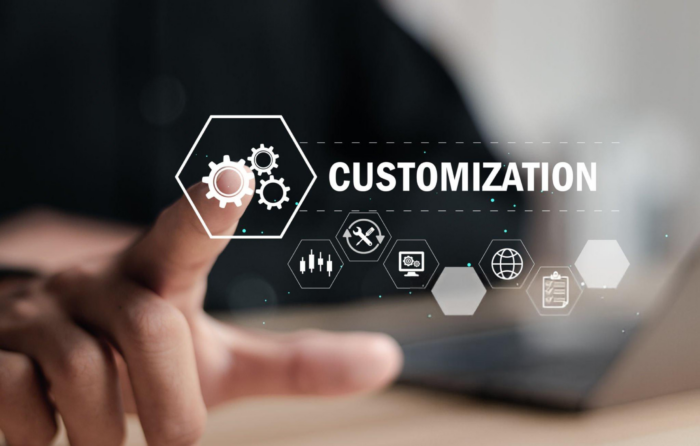
Why Customization Matters More Than Ever
In a fast-changing digital economy, how customization affects productivity is more than just a trend it’s a proven strategy for improving performance. Whether you’re designing employee workspaces or crafting personalized customer journeys, customization and personalization have a powerful impact on productivity. Why? Because at this level, it’s less about the product or the tool, and more about the individual using it.

In this post, we explore how customization affects productivity, drawing insights from two in-depth studies on individualized work environments and mass personalization in consumer behavior.
1. What Is Customization and Why Is It Important?
Customization refers to tailoring a product, service, or environment to meet individual needs or preferences. In the workplace, this could mean allowing employees to choose their desks, lighting, or seating arrangements. For consumers, it means getting recommendations, offers, and products that match their unique interests.
This is the same argument behind systems thinking a system built around how you actually work outperforms a rigid one every time, whether that’s a corner office or a Notion workspace.
But what does this mean for productivity?
2. How Customization Affects Productivity in the Workplace
A study titled The Effect of Individualized Work Settings reveals a direct link between workspace personalization and improved performance.

Key Benefits:
- Improved focus and concentration: Personalized spaces reduce distractions, boosting cognitive performance.
- Higher job satisfaction: Employees with control over their work environments report greater satisfaction and well-being.
- Better engagement: Customizing the workspace fosters a sense of identity and control, leading to deeper engagement and better output.
This isn’t just a workplace preference it’s a well-documented behavioral pattern called the IKEA effect: people value things disproportionately more once their own effort and choices are built into them. But the interesting part isn’t the one-time boost in satisfaction. It’s what happens when that experience repeats. Customize enough systems, enough times, and you stop being someone who occasionally personalizes a tool you become someone who builds their own by default. Notion Elevation calls that shift identity shift: the point where building your own system stops being an event and starts being who you are.
3. The Consumer Side: How Mass Personalization Boosts Business Efficiency
The Deloitte report Made-to-Order: The Rise of Mass Personalisation shows that personalization in customer experiences isn’t just about delight it’s about driving results.
Insights from the report:
- 🔍 Faster decision-making: Personalized recommendations help consumers choose products faster.
- 🔄 Reduced marketing waste: Targeted content is more effective, leading to higher ROI.
- 📈 Increased loyalty and revenue: Customers are more likely to return and spend more when their preferences are recognized.
“Well-executed personalization can deliver 5–8x the ROI on marketing spend and lift sales by 10% or more.” — Deloitte Consumer Review
From personalized emails to customizable product options, personalization leads to smarter, more efficient consumer behavior. Why? Because how a business treats someone shapes how that person experiences themselves in the interaction as a name in a database, or as someone whose preferences actually mattered.
That’s not just a satisfaction metric. It’s the same mechanism running underneath Section 1: the difference between a product and their product, just showing up on the customer side instead of the employee side.

4. Why Customization Is a Competitive Advantage
Customization isn’t a product advantage. It’s an experience advantage.
A mediocre product with a great customized experience will outsell a better product with a generic one.
This gets sharper in an AI-saturated landscape, not softer:
- Old competition: win on features, win on specs, win on metrics.
- New competition: feature parity is the baseline, not the edge competitors match features within a single product cycle.
- What’s left to compete on: not what the tool does, but how using it makes someone feel.
Empowered, not managed. Competent, not instructed. The author of the outcome, not a recipient of it.

This is the IKEA effect operating as strategy instead of psychology. Repeated enough times, it produces identity shift the user stops feeling like someone borrowing a system and starts feeling like someone who builds their own.
The real competitive advantage was never the customization feature. It’s the identity shift customization produces and that’s far harder for a competitor to copy than any feature ever was.
5. How to Apply Customization for Better Productivity
For employers:
- Offer flexible workspaces quiet zones and collaborative areas, so people can choose the environment that matches how they actually work, not how the floor plan assumes everyone works.
- Let employees personalize desks or digital tools. This isn’t a perk. It’s the IKEA effect at work a personalized setup gets used and defended; a standard-issue one gets tolerated.
- Use personality assessments to assign roles better. Fit isn’t just about skill match it’s about whether someone can bring their own judgment to a role, or whether they’re just executing someone else’s process.
For businesses serving customers:
- Leverage data for smarter product recommendations. Relevance is the entry point but relevance alone doesn’t create loyalty.
- Allow users to personalize services or interfaces. This is the step that turns a customer into a co-author of their own experience the same shift from user to builder that Section 4 argues is the real competitive advantage.
- Segment audiences for highly relevant communication. Generic messaging treats everyone like an average user who doesn’t exist. Segmentation is table stakes for even reaching the personalization conversation at all.

This is exactly why Notion Elevation templates are built to be customized, not just used a template that bends to fit your workflow is the difference between a tool you abandon and one you keep.”
Conclusion: Make It Personal, Make It Productive
Customization affects productivity in three concrete ways:
It reduces friction. It builds engagement. It boosts results.
In the age of AI and hyper-personalization, the businesses and individuals who fail to tailor experiences won’t just fall behind on features they’ll fall behind on something harder to copy: the feeling of ownership that keeps people using a system instead of abandoning it.
Customization isn’t a luxury. It’s a productivity strategy and increasingly, it’s an identity strategy too.
The system someone builds for themselves isn’t just more efficient. It’s the difference between using a tool and becoming someone who builds their own.
FAQs
How does this apply to Notion specifically?
Notion’s flexibility is exactly what the research on customization predicts should work a system that adapts to you produces more consistent use over time than a rigid app with fixed features.
Does customization really improve productivity, or is it just a preference?
Research on individualized work settings shows measurable gains in focus, satisfaction, and engagement not just comfort. The same principle applies to digital systems: a workspace that’s been shaped around how you actually work outperforms a generic one built for an average user who doesn’t exist.